My approach to reversing menopause symptoms
Whose menopause is it anyway?
Reclaim a life stage that has been misdiagnosed, rebranded and monetised
Something is very, very wrong
Less than a decade ago, most of us — me included — had barely heard the word menopause said out loud, let alone in public. Then suddenly it was everywhere. TV documentaries. Celebrity confessions. Campaigns. Podcasts. Supplement ads. Shining a light on menopause is, in principle, a good thing. But the framing of that light is the problem. And the message, however it is dressed, has been loud and clear: menopause is a horror show, caused by a deficiency built into our biology.
You can’t sleep. You can’t think. Weight piles on if you so much as look at a biscuit. You swing from rage to despair in a heartbeat. Confidence evaporates. Skin thins. Sex drive disappears. Women describe it as losing themselves. If that is your life right now, you do not need anyone to tell you that something feels very, very wrong.
And it has been wrong for a century — held in place by a deficiency model that says you are fragile by design
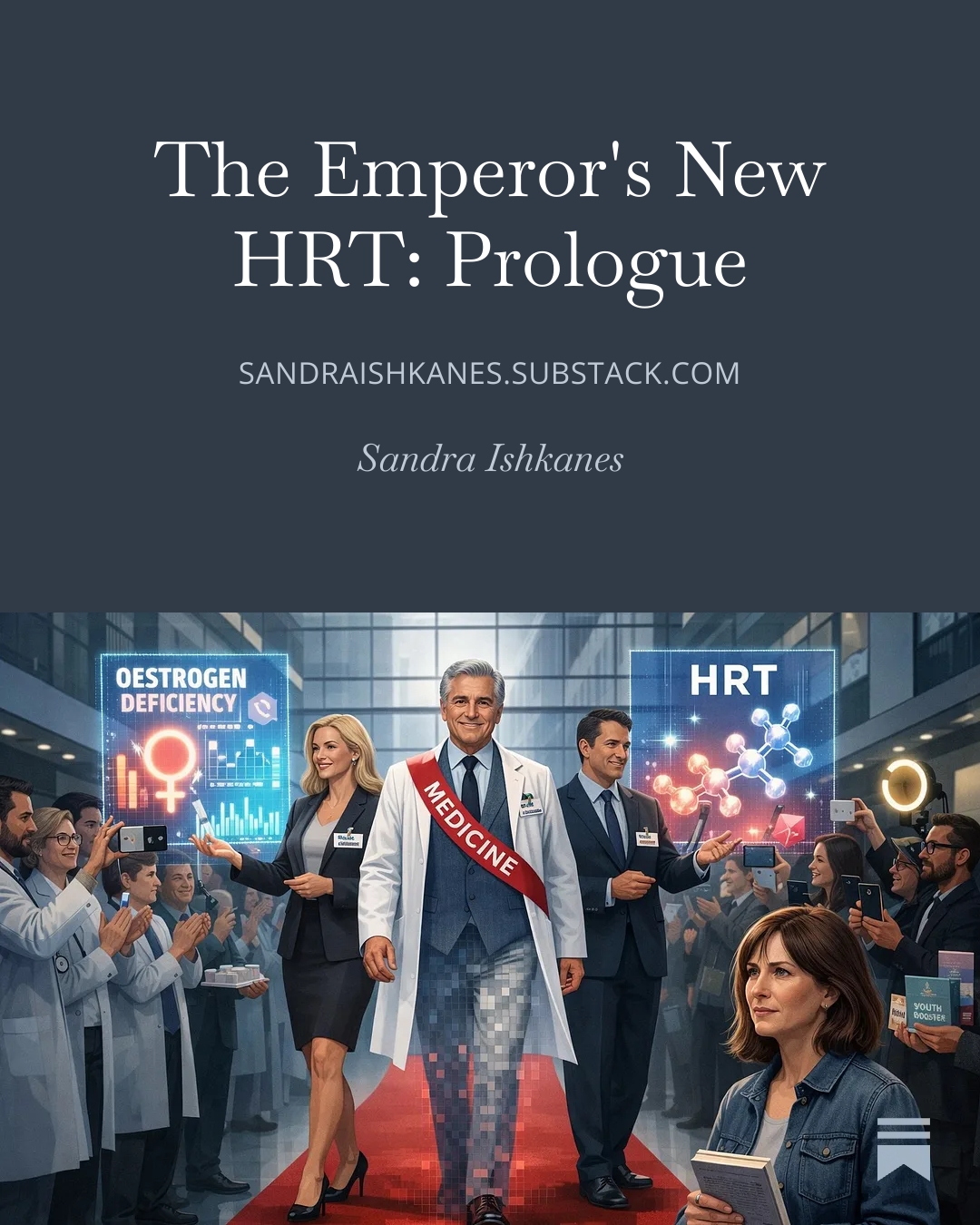
Medicine has, for the best part of a hundred years, defined menopause as an oestrogen deficiency state, and almost every account — from clinical guidelines to wellness influencers — is still built around that single definition. What mattered most about you, and defined your whole life, has now gone. The Deficiency Model was born in the laboratories of the twentieth century. It treats post-fertile life as a chronic disease in need of lifelong management.
Oestrogen deficiency is not, technically, a formal diagnosis. It has no ICD code, no billing line, no entry in the diagnostic manuals. And yet it functions as a diagnosis in every conversation that matters. Tell your GP, your friend, your employer, your pharmacist — I’ve been diagnosed with an oestrogen deficiency — and every one of them will understand exactly what you mean. The phrase explains the symptoms. It justifies the prescription. It validates the suffering as something tangible, treatable, real — rather than the loose, dismissible territory of just getting older.
This is how the Deficiency Model works. Not as an official diagnosis, but as a casual one underneath every conversation. It does the work of a diagnosis — applied not just to an individual, but to the entire post-fertile female population. Half the species, around their fiftieth year, has been casually diagnosed.
But there is a problem. A diagnosis of a thing — casual or otherwise — cannot also be the definition of that thing. And when you look closely at this contradiction, several critical issues come to light:
01
THE TRAP OF THE “NORMAL” BASELINE
The Deficiency Model assumes the hormonal state of a 25-year-old is the baseline for the rest of a woman’s life. Youth becomes the default ‘healthy’ state; any deviation, a deficit. We do not casually diagnose older adults with a growth hormone deficiency disease because they stopped growing taller. Only female biology is held to a standard it was never designed to maintain.
02
DIAGNOSIS OR DEFINITION?
If low oestrogen is the definition of the natural post-fertile state — the very thing that makes a woman post-fertile — then low oestrogen cannot also be the diagnosis for why she feels unwell. The same physiological fact is being asked to do two opposite jobs at once. It is being held up as what her body is supposed to be doing, and as what is wrong with her body. A definition and a diagnosis cannot cover the same ground.
03
THE POWER OF A CASUAL DIAGNOSIS OR DEFINITION?
The Deficiency Model persists because it solves a social problem. Before it, medicine dismissed menopausal women as hysterical or just ageing. Framing menopause as a hormone deficiency gave medicine a way to look like they are doing something, and gave women a way to demand serious medical attention and treatment. The tragedy is that to get validated, women had to accept being labelled fundamentally broken.
I broke the model
What about a woman without any symptoms? Does she have an oestrogen deficiency? The question messes with the definition. I know, because I am her: eight years post-menopause, and I have never had any symptoms. Women struggle to believe me, because the cultural script has made a menopause-without-suffering — and menopause without HRT — almost unthinkable. That is the depth of the story we are inside. A woman embodying the alternative is read as an impossibility, and yet I am not the only one — in societies around the world, not having symptom after symptom is the norm.
KEY FRAMING
The medical Oestrogen Deficiency Model treats menopause as a chronic disease in need of lifelong management.
The Adaptive Model says you have adapted, by design
I offer an alternative as a direct contrast — the Adaptive Model, grounded in evolutionary biology, anthropology, evidence-based science and a decade of clinical observation, which says menopause is not a failure but a designed transition into a different biological configuration. The high-oestrogen state of fertile years was designed for fertile years — not for life. After that, the body moves into a different configuration, by design.
When the Deficiency Model treats the baseline as sickness, it loses the ability to distinguish between the rewiring itself and the difficulty some bodies have during the rewiring. The transition and the suffering collapse into the same word. The Adaptation Model separates them. The transition is universal. The suffering is optional.
A post-menopausal woman is not a faulty younger woman. She is a different biological design, doing what she was always coded to do.
KEY FRAMING
A post-menopausal woman is not a faulty younger woman. She is a different biological design, doing what she was always coded to do.
Two models, same body.
Here is what each one says.
THE DEFICIENCY MODEL
What you’ve been told
Your body has failed
Your ovaries have stopped working. You are running out of oestrogen.
You need HRT
Pharmaceutical oestrogen replacement is the responsible choice.
Your symptoms are inevitable
Hot flushes, brain fog, joint pain are evidence of what’s missing.
No HRT = suffering
Going without is either suspicious, ideological, or naïve.
THE adaptive MODEL
What biology shows
You have adapted
Ovarian retirement is the trigger for 3 biological shifts to come online.
You are building something new
The brain switches fuel sources, tissues take over local oestrogen production and your emotional state transitions.
Symptoms = compensation lag
Symptoms show where the new system needs support.
No HRT = default
Most women throughout human history reached this stage and lived decades beyond it in health.
Menopause has succeeded for 1.5 million years
Evolution does not preserve biology that leads to half the population being too sick to function. The long post-reproductive years exist because women living well past menopause are part of the reason humans are still here — shaping communities, holding knowledge, preserving and shaping culture, raising and supporting younger generations, freeing daughters to raise more children at shorter intervals. We are not a glitch in the system. We are part of what made the system succeed.
Ancient
Anthropologists estimate that menopause is 1.5
million years old — older than agriculture, older than language, older than civilisation
itself.
Selected for
If menopause were a biological mistake, it would have been
bred out long ago. Instead, it has
persisted, written into the our human design.
Essential
Post-reproductive women carried memory, language,
ritual and food knowledge — the cultural infrastructure that allowed our species to endure.
Until now
The design held for one and a half million years. It held through ice ages, famines, migrations, plagues. Modern life is the first environment it cannot run in. Relentless stress, broken sleep, ultra-processed food, chronic sugar and starch overload, chemical loads, invisible caregiving, social isolation. The ancient code is still trying to run — but the environment around it has changed beyond recognition, and changed in a single lifetime.
So what about the symptoms? They are not the failure of your body. They are the signal of a body running ancient software in a modern operating system. Menopause is not the problem, but the context is. Which means that the misery is optional, because when you change the conditions, the symptoms resolve. Menopause without HRT should be our default position, not a suspicious alternative.
KEY FRAMING
Menopause is not the problem. The context is. Change the conditions and the symptoms resolve.
The colonisation of menopause
The vulnerabilities in the menopausal design have been cracked open by too much sugar and starch, deficiencies in protein, fat, vitamins and minerals, the life lived in a patriarchy – and got filled by the industries best placed to sell into the gap:
Doctors and pharma. Trained inside the deficiency model and incentivised to prescribe. HRT is the easy answer, the billable answer, and the one the guideline tells them to give. Most GPs have never been taught the shifts even exist.
The wellness industry. Menopause turned into a marketing category. Anti-ageing creams, peptide stacks, collagen powders, hormone-balancing teas. Every symptom becomes a product line; every product line becomes a subscription.
Influencers and media celebrities. Often promoting HRT, supplement bundles or branded protocols. The framing sounds feminist — but the model underneath is still deficiency, still purchase-based, still framed around what is wrong with you.
All the while telling you that you are not broken – you just need more oestrogen.
Whose menopause is it anyway? Your answer will shape your future
Does your menopause belong to doctors and pharmaceutical corporations? To the supplement and beauty companies who have turned a life stage into billion-dollar industries? To the influencers and media celebrities who have made themselves the face and voice of all of menopause?
Or can we take it back? Can we dismantle the “broken woman” myth — the century-old story that says a woman past fertility is, by definition, a diminished woman? Can we stop deferring to people who do not live inside our bodies, telling us what our bodies are – or should – be doing?
Who gets to tell the story of your menopause? The answer you choose is not abstract. It will shape how you understand your symptoms. It will shape the decisions you make about treatment. It will shape the kind of health you build in the decades ahead.
NEXT · A DIFFERENT STARTING POINT
If menopause is adaptation, not deficiency, then care looks completely different.
It begins not with what to replace, but with what to support. Three biological shifts — Energy, Oestrogen, and Emotional — are now underway in your body. Each has its own mechanism. Each has its own symptom signature. Each has its own way of being supported.