Perimenopause and Menopause Explained
The journey from early perimenopause to post-menopause is a series of biological shifts, each with a different hormonal driver, a different symptom cluster, and a different clinical need. Understanding which shift you are in is the first and most important question.

By Sandra Ishkanes, Functional Medicine Practitioner, specialising in perimenopause and menopause. I hold a BSc in Molecular Biology from King’s College London, MA in Social Anthropology from SOAS, trained in nutritional therapy and functional medicine at the Institute of Optimum Nutrition, and I am a registered member of the Association of Naturopathic Practitioners (ANP).
You’ve been told you’re in perimenopause. Maybe your GP said it, or a specialist mentioned it in passing, or you’ve read it in a dozen articles that all seem to say the same vague things. And yet — you’re still confused. Because what you’re experiencing doesn’t seem to fit neatly into any of the explanations you’ve been given.
Maybe you’re flooding through a tampon every hour and your periods have become unpredictable and violent — but the articles you’re reading are talking about hot flushes and night sweats, which you don’t really have. Or maybe you do have the hot flushes and the brain fog, but you also tried HRT and it made things worse, not better. Or perhaps you have both sets of symptoms at different times and you can’t make sense of what’s happening inside your body.
Here is the reason you’re confused: perimenopause is not one thing.
It is two distinct biological phases — with different root causes, different hormone behaviour, different dominant symptoms, and different clinical needs. Most doctors, most practitioners, and most information you’ll find online treats perimenopause as a single entity. That single-entity model is why so many women receive the wrong help, why HRT is sometimes prescribed when it doesn’t fit, and why women spend years cycling through interventions that don’t work.
This page is the explanation you haven’t been given. It is also the foundation of everything I do in my practice.
The Two-Phase Model: Why This Changes Everything
The conventional model runs like this: your ovaries wind down, oestrogen drops, symptoms follow until periods stop. Treatment — replace the oestrogen.
That model is incomplete, and the incompleteness causes harm.
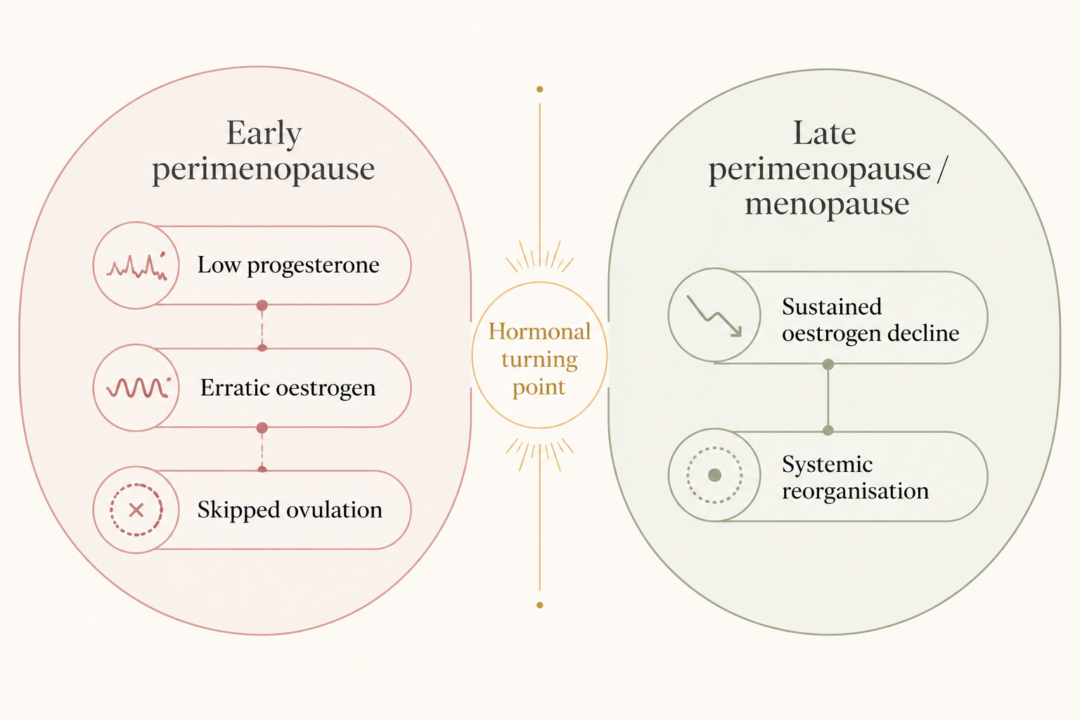
Perimenopause has two biologically distinct phases, separated by a hormonal turning point most practitioners never identify. The two phases have opposite oestrogen dynamics, opposite cycle patterns, and need opposite clinical approaches. Collapse them into one “perimenopause” category and you get the failed care that sends women in circles.
Which phase you’re in is the first question that needs to be answered.
Phase One: Early Perimenopause
Early perimenopause is not primarily about oestrogen going low — that misconception drives most treatment failures in this phase.
It’s driven by two compounding processes: follicle depletion and ovarian fibrosis. Together they disrupt ovulation, and it’s the loss of ovulation — not the loss of oestrogen — that creates the hormonal picture of this phase.
The sequence:
- Your ovaries hold a finite reserve of follicles — the fluid-filled sacs that house your eggs and make hormones. That reserve declines all your life, but through your late thirties and forties the decline speeds up.
- As fewer follicles remain, your pituitary works harder, releasing more FSH (follicle-stimulating hormone) to recruit a dominant follicle each cycle.
- Meanwhile, every ovulation causes small tissue trauma to the ovarian surface. Over decades, that cumulative trauma triggers an inflammatory repair response: TGF-β activates fibroblasts, which lay down collagen, and the ovarian cortex stiffens. This is ovarian fibrosis, recognised in the literature only recently.
- Stiff, fibrotic tissue compresses the remaining follicles and blunts their response to FSH — gonadotropin desensitisation. The follicles are still there, but they’ve gone hard of hearing. The brain shouts louder (FSH rises), the response stays erratic.
The result: skipped ovulations. Some cycles complete, others don’t. When ovulation is skipped there’s no corpus luteum — the temporary gland that forms after ovulation and makes progesterone. No corpus luteum, no progesterone surge in the second half of the cycle.
That’s the defining picture of early perimenopause: progesterone crashes while oestrogen keeps fluctuating at normal or elevated levels. Not an oestrogen problem — an oestrogen-to-progesterone ratio problem. Oestrogen is unchecked.
What oestrogen is doing
It doesn’t go low — it goes wild. Chaotic follicle recruitment makes oestrogen swing hard: a spike to hyper-physiological levels during an aggressive follicular phase, then a crash when that follicle fails to ovulate. Next cycle, normal. The one after, another spike. This is the oestrogen rollercoaster — not a slow decline but an erratic lurch between extremes.
What FSH is doing
Just as unstable. Because some cycles recruit and ovulate and others don’t, FSH bounces between reproductive-age and post-menopausal ranges week to week. One blood test can read completely normal one month and dramatically high the next.
This is why a single FSH measurement here is almost meaningless — it captures one week’s follicular activity and tells you nothing about the whole. Women in early perimenopause are routinely told their FSH is “normal” and therefore they can’t be perimenopausal. That’s a failure of interpretation, not a failure of their biology.
Cycle pattern
The hallmark is variability of 7 or more days from your baseline. A reliable 28-day cycle now ranging 21–35 days puts you here. Periods are still present — often very present — but irregular: some cycles longer, some shorter, with spotting or mid-cycle bleeding.
Symptoms of early perimenopause
All of them flow from the same root — low progesterone relative to oestrogen:
- Heavy, prolonged, or flooding periods — without progesterone to regulate shedding, the lining builds then sheds dramatically
- Rage and sudden irritability — progesterone is neurologically calming; its absence creates a hair-trigger state
- Breast tenderness — unopposed oestrogen stimulates breast tissue
- Bloating and water retention — oestrogen holds fluid; without progesterone to counterbalance, bloating dominates
- Menstrual migraines — tied to oestrogen surges and crashes across the cycle
- Anxiety — progesterone modulates GABA receptors for a calming effect; its absence amplifies anxiety, especially pre-menstrually
- Poor sleep — progesterone drives slow-wave sleep; low progesterone means fragmented, unrefreshing sleep
- Worsening PMS — the premenstrual phase sharpens as the progesterone deficit deepens
Why HRT often makes early perimenopause worse
Standard HRT — especially oestrogen-dominant preparations — is built to correct an oestrogen deficiency. In early perimenopause there is no oestrogen deficiency: oestrogen is erratic and unchecked by progesterone. Add more oestrogen and you’re feeding an already unstable fire. Many women placed on HRT in this phase report worse symptoms — more anxiety, heavier bleeding, more breast tenderness, deeper mood instability. The biology explains it exactly.
Early perimenopause needs the opposite approach: support progesterone, address the inflammatory drivers of ovarian fibrosis, and reduce oestrogen load rather than add to it.
Educational, not medical advice — any change to HRT is a decision for you and your prescriber.
Phase Two: Late Perimenopause
The hormonal turning point
At some point the follicle supply drops below a critical threshold. The erratic recruitment of the earlier years gives way to something different: oestrogen now declines consistently and persistently. The rollercoaster ends. A new set of challenges begins.
Late perimenopause starts when you begin skipping whole cycles — the clinical marker is a gap of 60 or more days between periods. Past that point, the follicle supply can no longer sustain consistent cycle activity.
FSH, which was bouncing unpredictably, now climbs steadily and doesn’t stop; it reflects the persistent absence of follicular feedback. This is the pattern many practitioners recognise as “perimenopausal” on a blood test, because it’s finally consistent enough to be informative.
What changes
Oestrogen is now genuinely and consistently low. The follicles driving those wild spikes are no longer available in meaningful numbers. For some women this is a relief at first — the flooding eases, the breast tenderness fades, the violent surges settle. Then a more complex set of changes takes their place.
Falling ovarian oestrogen triggers three biological reorganisations that run at the same time.
1. The Energy Shift — a brain energy crisis. Oestrogen isn’t only reproductive — it’s a master regulator of how the brain uses glucose for fuel. When it falls, the brain’s main energy supply becomes less efficient. This is the neurological root of the symptoms most associated with menopause: hot flushes (the hypothalamus misfiring on temperature regulation), brain fog and word-retrieval trouble, and an anxiety driven now by cortisol and adrenaline as the body hunts for alternative brain fuel. Fatigue, low mood, palpitations, central weight gain — all expressions of the same fuel crisis.
2. The Oestrogen Shift — an oestrogen handover. As the ovaries step back, the body relocates hormone production rather than stopping it. The adrenals supply a precursor called DHEA, and individual tissues — bone, muscle, skin, brain, vagina — convert it locally into whatever they each need. This tissue-level system has a name — intracrine hormone production: hormones made and used right inside the tissue. Well-resourced, it’s elegant. Under-resourced — through chronic stress, blood sugar instability, or nutritional depletion — it produces joint pain, muscle loss, thinning skin, vaginal dryness, cognitive slowing, plus the chin hair and crown thinning that insulin drives through a separate pathway. These can appear while cycles are still happening — the handover has already begun.
3. The Emotional Shift — a nervous system reorganisation. The hormonal architecture behind the tend-and-befriend stress response — oestrogen and oxytocin — starts withdrawing. Coping through connection, smoothing, and accommodation begins to cost more than it returns. You may notice the pulling-back, the harder time tolerating dynamics that once felt manageable, a rage harder to place than the early-perimenopause kind. Not a breakdown and not a personality change — a nervous system beginning to reorganise, away from accommodation and toward something more autonomous.
These don’t wait for each other. In late perimenopause many women manage all three at once — the brain energy crisis, the tissue handover, the start of emotional reorganisation — without anyone having named what’s happening.
Symptoms of late perimenopause
Distinct from early perimenopause, driven by unsupported oestrogen decline rather than progesterone decline:
- Hot flushes — the hypothalamus loses oestrogen-regulated thermostat control and misreads core temperature
- Night sweats — the same mechanism in sleep, feeding the fatigue cycle
- Brain fog and word-retrieval problems — reduced glucose metabolism in prefrontal and hippocampal regions
- Anxiety of a different quality — cortisol and adrenaline surges as the body mobilises alternative brain fuel; distinct from the progesterone-withdrawal anxiety of early perimenopause
- Heart palpitations — oestrogen receptors in cardiac and vascular smooth muscle lose activation
- Fatigue — metabolic inefficiency compounded by broken sleep
- Low mood — oestrogen modulates serotonin and dopamine; steady decline reduces emotional resilience
- Weight gain, especially abdominal — declining oestrogen shifts fat toward visceral tissue
- Joint pain and stiffness — early sign of the tissue handover; the bone pathway losing its local oestrogen supply
- Muscle loss despite exercise — the muscle–testosterone intracrine pathway under-resourced
- Withdrawal and emotional volatility — the tend-and-befriend system retreating
As these emerge, the early-perimenopause symptoms typically ease. The flooding lightens then grows scarce. Breast tenderness reduces. The progesterone-decline rage settles — not because hormonal health improved, but because the oestrogen surges driving it have stopped. The signal has changed. The problem has changed. The clinical response has to change with it.
Menopause and Post-Menopause
Menopause is a single point in time, not a phase: 12 consecutive months without a period. Everything leading up to it is perimenopause.
Once you pass 12 months, post-menopause begins and lasts the rest of life. The processes that started in late perimenopause — the tissue handover and the nervous system reorganisation — keep developing. The brain energy crisis, left unaddressed, persists and compounds. The DHEA-based intracrine system becomes your primary hormone architecture. And the nervous system completes its move from accommodation-based to agency-based regulation — a shift that, supported well, many women describe as the clearest and most grounded they’ve felt.
Post-menopause isn’t the end of the hormonal story. It’s a different chapter — different biology, different needs, different possibilities.
Phase Comparison at a Glance
| Feature | Early Perimenopause | Late Perimenopause |
| Cycle Pattern | Variable by 7+ days from baseline | Skipped cycles — gaps of 60+ days |
| Oestrogen Levels | Wildly fluctuating (spikes and crashes) | Consistently and persistently low |
| FSH Behaviour | Bounces unpredictably week to week | Steady, non-stop upward climb |
| Primary Bleeding | Heavy, prolonged, flooding | Scanty, rare, or absent |
| Dominant Symptoms | Heavy periods, rage, breast tenderness, anxiety, worsening PMS | Hot flushes, night sweats, brain fog, fatigue, low mood, palpitations |
| HRT Response | Often worsens symptoms | More straightforwardly applicable |
| Root Hormonal Driver | Progesterone decline / oestrogen dominance | Oestrogen decline |
The Four Shifts: A Map of the Full Transition
My clinical framework organises the whole transition — from the first erratic cycles to post-menopause — into four named shifts. Each has its own hormonal driver, symptom cluster, and clinical need. They’re not stages on one continuum; they’re four genuinely different physiological states
| Shift | Phase | Hormonal Driver | Primary Symptoms |
| 01 — The Progesterone Shift | Early perimenopause | Progesterone decline / oestrogen dominance from anovulatory cycles | Heavy periods, rage, breast tenderness, worsening PMS, anxiety, poor sleep |
| 02 — The Energy Shift | Late perimenopause | Oestrogen decline → brain bioenergetic crisis | Hot flushes, night sweats, brain fog, fatigue, palpitations, central weight gain |
| 03 — The Oestrogen Shift | Late perimenopause | DHEA-driven intracrine hormone production begins as ovarian output falls | Joint pain, thinning skin, vaginal dryness, muscle loss, cognitive changes, chin hair |
| 04 — The Emotional Shift | Late perimenopause | Testosterone and DHEA become increasingly dominant as oestrogen and oxytocin recede | Rage, withdrawal, identity reorganisation, the emergence of agency-based regulation |
This framework is why support in early perimenopause looks completely different from support in late perimenopause and beyond. Applying the same hormonal lens to all four shifts — as conventional medicine often does — produces the wrong answers at every stage. An important clinical point: Shifts 03 and 04 begin emerging in late perimenopause as oestrogen reaches its lowest levels — which means a woman in her late 40s skipping cycles may be experiencing all three of Shifts 02, 03 and 04 simultaneously.
For dedicated coverage of each shift, use the internal navigation at the bottom of this page.
How to Identify Which Phase You’re In
The clearest diagnostic tool is also the simplest: your cycle pattern.
Check your cycle first:
- Periods still present but irregular, arriving anywhere from 3 to 5 weeks apart when they used to be predictable? Early perimenopause. The 7-day variability criterion is clinically established — cycles varying more than 7 days from baseline means the early transition has begun.
- Skipping entire cycles — gaps of 60 days or more? Late perimenopause. Once a 60-day gap occurs, the late phase has begun.
Then check your symptoms:
- Heavy or flooding periods, breast tenderness, premenstrual rage, anxiety that worsens the week before your period, poor sleep throughout the cycle → early perimenopause, progesterone decline driving it.
- Hot flushes, night sweats, brain fog, fatigue, palpitations, central weight gain → late perimenopause, oestrogen decline and the brain energy crisis.
One caveat: both phases can coexist in the transition between them. Some women have symptoms of both at once — residual cyclical symptoms from progesterone decline alongside early vasomotor symptoms. This overlap window is real, and it’s one reason perimenopause feels so bewildering. The phases blur into each other, which is exactly why precise symptom mapping matters more than any single blood test.ases are not always perfectly sequential — they blur into each other, which is precisely why precise symptom mapping matters more than any single blood test.
The FSH Staging Timeline
The Study of Women’s Health Across the Nation (SWAN) — one of the most comprehensive longitudinal studies of the menopausal transition — identified four stages in FSH behaviour relative to the final menstrual period (FMP):
- Stage 1 — Slow early drift (up to 7 years before FMP): FSH drifts upward slowly, without the dramatic swings to come. Cycles still regular. Most women notice nothing. FSH at age 42 averages around 8 mIU/mL.
- Stage 2 — The rollercoaster (7 to 2 years before FMP): FSH accelerates, but erratically, bouncing between normal and elevated from cycle to cycle as follicle recruitment turns chaotic. This is early perimenopause. Values climb from roughly 15 to 33 mIU/mL, with dramatic week-to-week variation. A single reading tells you almost nothing.
- Stage 3 — Acute acceleration (2 years before to 1 year after FMP): the sharpest hormonal shift in a woman’s reproductive life. FSH climbs steadily from ~34 to ~54 mIU/mL. Oestrogen now declines in earnest. This is the late perimenopause–early postmenopause transition; the onset of 60-day cycle gaps signals it has begun.
- Stage 4 — Plateau (1 to 2 years post-FMP): FSH stabilises at a sustained high — typically 70–90 IU/L — and stays there. The reproductive axis has permanently reorganised.
After the plateau, FSH gradually declines over subsequent decades (perhaps 30–50% from peak in very late life), but the woman remains postmenopausal throughout.
The clinical implication: because FSH bounces so much in Stages 1 and 2, a single measurement in early perimenopause can read entirely normal for a reproductive-age woman. That doesn’t mean perimenopause isn’t happening — it means the test caught a trough. Serial, well-timed measurements are more informative, but even then FSH alone can’t tell you which phase you’re in.
The Dual Mechanism: Why Some Women Have a Much Harder Perimenopause
Why do some women pass through perimenopause with manageable symptoms while others live years of debilitating hormonal chaos?
Part of the answer is the dual mechanism driving early perimenopause: follicle depletion and ovarian fibrosis working together.
Follicle depletion is the primary driver. Fewer eggs means fewer follicles for recruitment each cycle, which means more erratic output. This much is broadly understood.
Ovarian fibrosis is the compounding accelerator. Repeated ovulations over decades cause cumulative microtrauma to the ovarian surface. That triggers an inflammaging response — the same chronic, low-grade inflammatory pathway behind tissue aging throughout the body. TGF-β activates fibroblasts into myofibroblasts, which deposit collagen into the ovarian stroma, and the cortex stiffens. A stiffer cortex physically compresses remaining follicles, making them less sensitive to FSH (gonadotropin desensitisation). The pituitary, sensing weak feedback, produces even more FSH — but more FSH can’t compensate for follicles that can’t hear it. Result: more erratic recruitment, more skipped ovulations, more progesterone crashes, more oestrogen swings.
Fewer follicles and deafer follicles multiply each other. The combined disruption is greater than either alone.
What accelerates fibrosis — and therefore accelerates and amplifies early perimenopause:
- Insulin resistance and obesity — activate the NLRP3 inflammasome pathway, driving more TGF-β signalling and faster collagen deposition in ovarian tissue
- Chronic stress and sustained cortisol — suppress the enzymes (matrix metalloproteinases) that break collagen down, and cause granulosa cell apoptosis that impairs follicle development
- Endometriosis — ovarian endometriomas drive iron-overload oxidative stress and fibrotic remodelling inside the ovary
- PCOS — its chronic low-grade inflammation accelerates stromal fibrosis independent of ovulatory disturbance
- Smoking — a well-documented accelerant of follicle depletion and ovarian aging
- Endocrine-disrupting chemicals (EDCs) — impair FSH receptor signalling and add to ovarian inflammatory burden
- Nutrient deficiencies — particularly Vitamin D (anti-fibrotic via TGF-β inhibition), antioxidants, zinc, and magnesium (all required for granulosa cell function and anti-inflammatory pathways)
If you have insulin resistance, years of chronic stress, endometriosis or PCOS, or significant nutrient gaps, you’re likely to have earlier and more severe early perimenopause. Not bad luck — a biological mechanism that can be understood and addressed.
Where to Go From Here
Understanding which shift you’re in is the starting point for everything else. From here the four pathways diverge:
- Heavy periods, rage, breast tenderness, worsening PMS — cycles irregular but present: → Early Perimenopause — The Progesterone Shift →
- Hot flushes, night sweats, brain fog, fatigue — skipping entire cycles: → Late Perimenopause — The Energy Shift →
- Post-menopausal with joint pain, thinning skin, vaginal dryness, muscle loss, chin hair: → Post-Menopause — The Oestrogen Shift →
- The anger, withdrawal, and identity shift of menopause: → The Emotional Shift — From Belonging to Becoming →
Want to work through it with me?
If you’ve read this and you’re still uncertain — or you have symptoms from both columns and don’t know what to make of it — that’s exactly the clinical complexity I work with every day.
A 1.5 hour assessment maps your symptom pattern, reviews your cycle history, interprets any existing test results through the four-shift model, and gives you a clear picture of where you are and what your next step should be.
References
- Sowers MF, Zheng H, McConnell D, Nan B, Harlow S, Randolph JF Jr. Follicle stimulating hormone and its rate of change in defining menopause transition stages. J Clin Endocrinol Metab. 2008;93(10):3958–3964. doi:10.1210/jc.2008-0482
- Harlow SD, Gass M, Hall JE, et al. Executive summary of the Stages of Reproductive Aging Workshop + 10: addressing the unfinished agenda of staging reproductive aging. Menopause. 2012;19(4):387–395. doi:10.1097/gme.0b013e31824d8f40
- Randolph JF Jr, Zheng H, Sowers M, et al. Change in follicle-stimulating hormone and estradiol across the menopausal transition: effect of age at the final menstrual period. J Clin Endocrinol Metab. 2011;96(3):746–754. doi:10.1210/jc.2010-1746
- Gu M, Yu Y, Wang Y. Ovarian fibrosis: molecular mechanisms and potential therapeutic targets. J Ovarian Res. 2024;17(1):134. doi:10.1186/s13048-024-01448-7
- Morimoto A, Andreas E, Williams EJ, et al. Female reproductive life span is extended by targeted removal of fibrotic collagen from the mouse ovary. Sci Adv. 2022;8(24):eabn4564. doi:10.1126/sciadv.abn4564
- Duncan FE, Briley SM, Jasti S, et al. Reproductive age-associated fibrosis in the stroma of the mammalian ovary. Reproduction. 2016;152(3):245–260. doi:10.1530/REP-16-0129
- Shirafuji A, Tamamura C, Tsuyoshi H, et al. Chronic low-grade inflammation and ovarian dysfunction in women with polycystic ovarian syndrome, endometriosis, and aging. Front Endocrinol. 2023;14:1324429. doi:10.3389/fendo.2023.1324429
- Trumble BC, Holman DJ, Brindle E, et al. Progesterone and ovulation across stages of the transition to menopause. Menopause. 2010;17(6):1183–1192. doi:10.1097/gme.0b013e3181aa192d
- Rettberg JR, Yao J, Brinton RD. Estrogen: a master regulator of bioenergetic systems in the brain and body. Front Neuroendocrinol. 2014;35(1):8–30. doi:10.1016/j.yfrne.2013.08.001
- Brinton RD, Yao J, Yin F, et al. Perimenopause as a neurological transition state. Nat Rev Endocrinol. 2015;11(7):393–405. doi:10.1038/nrendo.2015.82
- Johnson BW, Duncan FE, Kelsh J, et al. Fibroinflammatory signatures increase with age in the human ovary and follicular fluid. Int J Mol Sci. 2021;22(9):4902. doi:10.3390/ijms22094902
- Karvonen-Gutierrez C, Greendale GA, Matthews K, et al. The menopause transition and women’s health at midlife: a progress report from the Study of Women’s Health Across the Nation (SWAN). Menopause. 2019;26(10):1213–1227. doi:10.1097/GME.0000000000001424